
Decades ago, when we first came to Alaska, there was a place in town that made superb smoked fish. We loved it. They would also clean and vacuum seal our fish when we had too many to do ourselves, and when we had those bounties we’d have them smoke some of them, too. Superb.
But then the business changed. One year, they were unable to do any of our fish, and we burned up two FoodSaver home vacuum sealers doing them ourselves. They also stopped offering the exquisite variety of smoked fish that they used to make and sell. We’ve since taken over all of our own fish processing, and finally a couple of years ago I decided to figure out how to make decent smoked fish, too.
I’ve been seeing people complain about too much story telling online before the recipes are divulged, so I’ll put the rest of the story down below.
We use up last year’s fish before dipping into this year’s – when the current year has been good and we have some from last year. Trim fish for any freezer burn.
Brine: 4:1.25 brown sugar to salt. I’ve been using 4 cups sugar to 1.25 salt in a gallon of water. I could probably get away with less for five fish (10 sides, each side cut in half, so 20 pieces).
Brine for 1.5 hours, stirring every 15 minutes to ensure good exposure. I drop the fish straight in as I unbag, rinse, and trim them (they are thawed first). I start the clock as the last fish goes in.
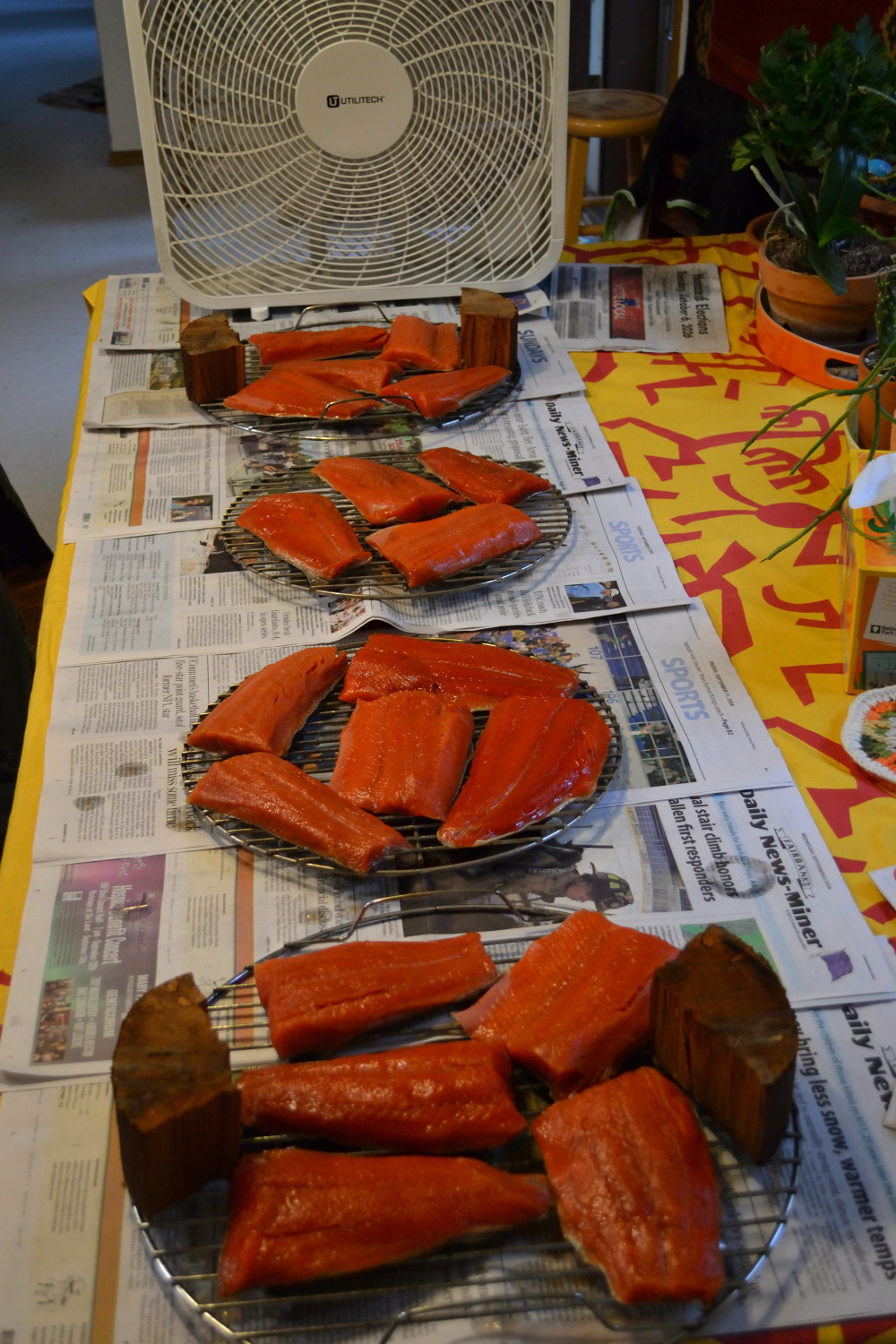
Brined red salmon fillets drying.
Place the grills on newspaper and on something else to keep them from sticking to the paper. I just use steak knives. Give the grills a light coat of cooking oil (helps with cleanup) before putting the brined fish onto them. Optimize spacing so they don’t touch each other but do fill the grills. Pat the fillets dry-ish to speed the drying stage. Use a fan to blow across the fish to dry them for two hours. The surfaces should be tacky.
Have the smoker ready to go with damp wood chips on the element but no water in the water bowl (see below for our rig). Load it, turn it on, and monitor the temperature. I end up checking it every 10-15 minutes for a 2-3 hour smoke. Add more wood chips on the hour through the lower hatch. I find that a trowel helps with this to get good element coverage (at least near the trap door). On our smoker, the rheostat is very approximate, and the temperature varies with outdoor temperature, wind, rain, and amount of wood chips on the element. Every batch is different. If the temperature is too high, e.g., 170-180 F, it will be done in an hour and not be smoky enough. I’ve been having better outcomes bringing it up to 140 F slowly to ensure a long smoke, and then accelerating it to 160-180 F at around 2 hr. You want an internal temp of 140 F. I’ve done it enough now that I can just poke the fish and tell if it’s cooked enough.
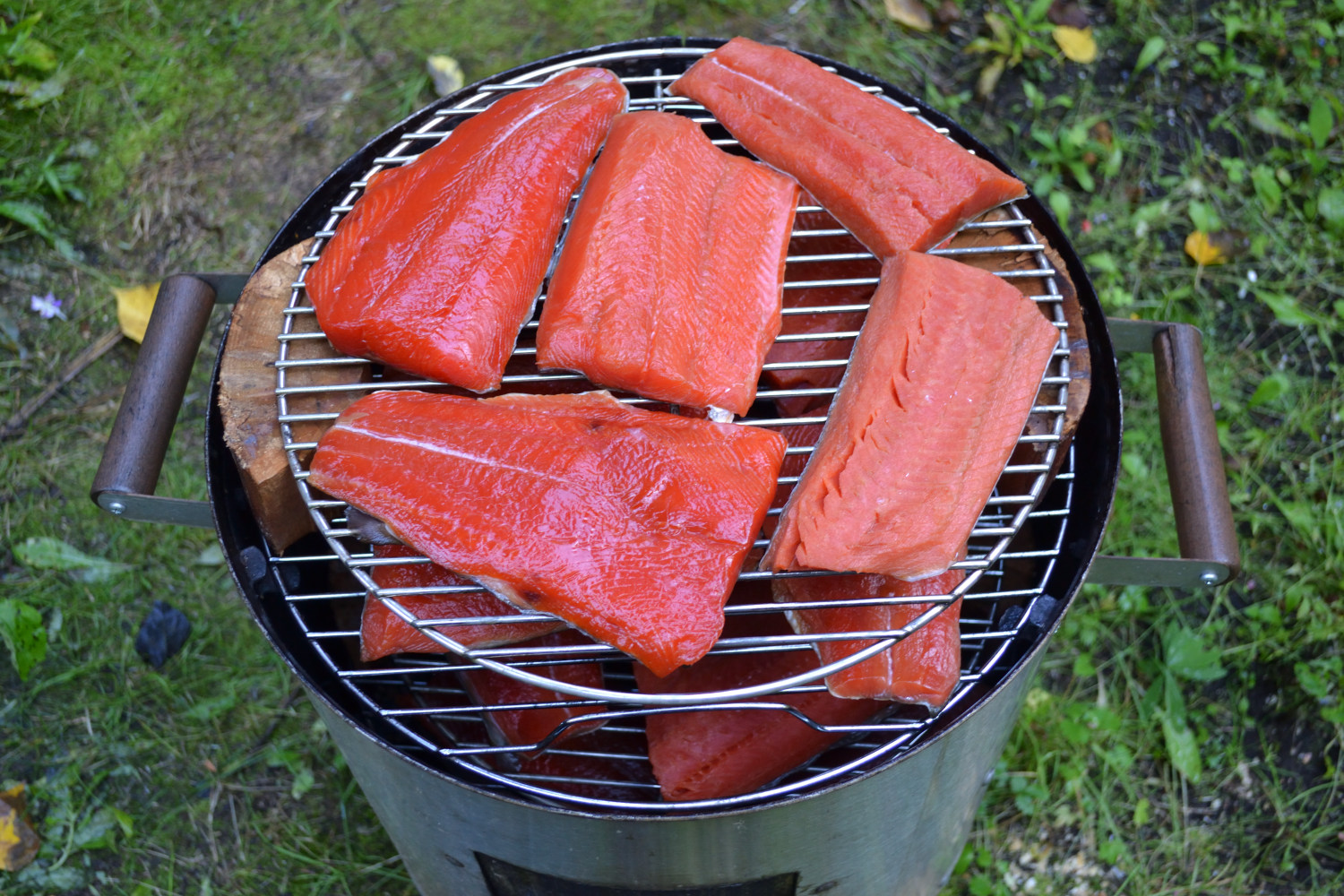
Smoker loaded with brined and slightly dried red salmon fillets.
When it’s done we spread it back out on the table inside and pat it dry and let it cool. We’ve generally been putting it into containers and into the fridge overnight and then vacuum sealing it and putting it into the freezer the next day. Of course it is imperative to hold a couple of pieces back to eat while fresh.
So, the rest of the story:
I tried several methods that I found online before juggling our fish and equipment to achieve a product that we like – a lot. Dry brining did not produce what we were looking for (too dry and salty), and a liquid brine needed ingredient tinkering, too. Then there is our smoker. It is a Meco electric water smoker that my sister Mary gave to us a long time ago. It is a wonderful tool for smoke cooking, but we hadn’t used it as a smoker before. (It has featured in previous posts, once for smoke-cooking moose heart and another time for crane).
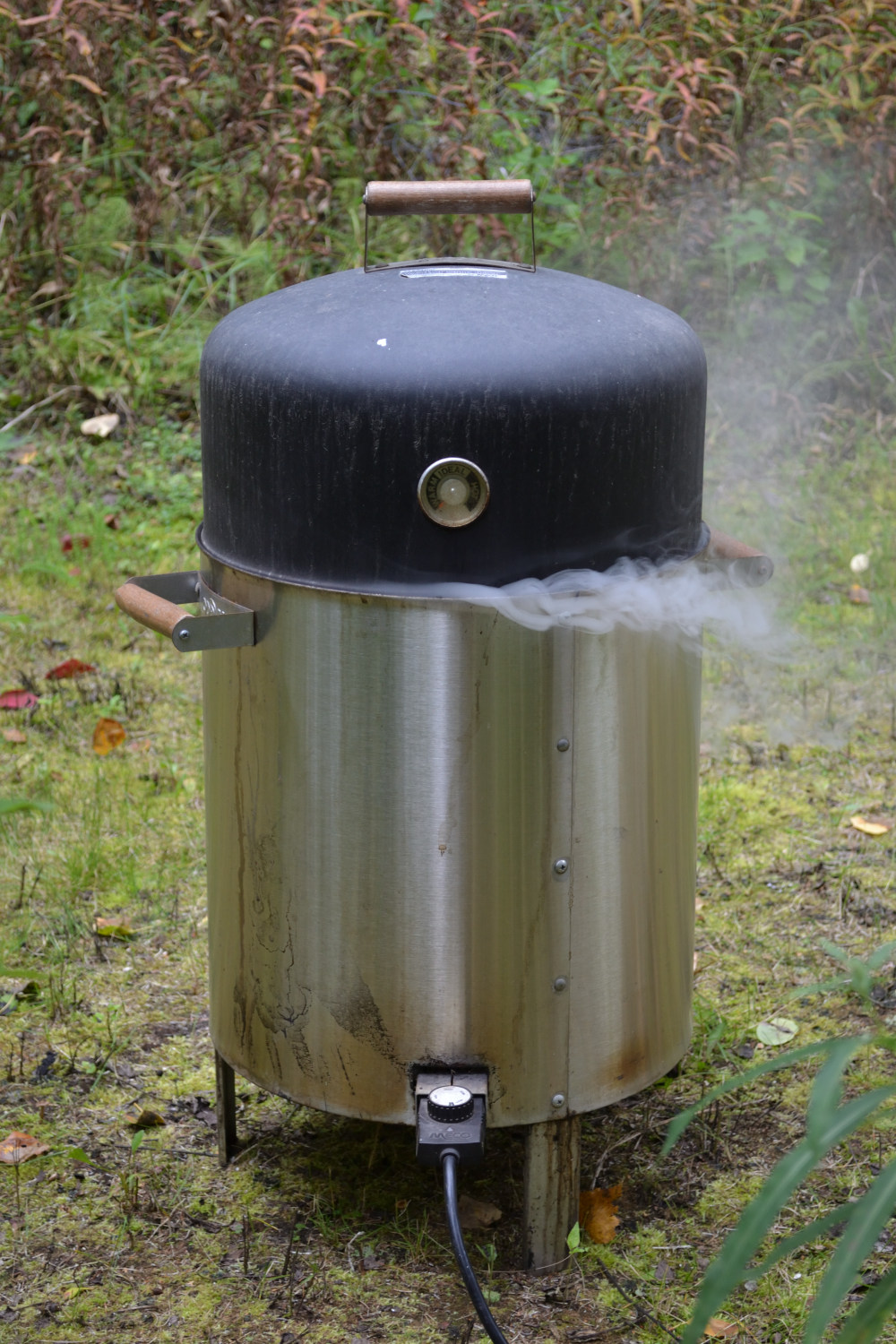
Meco electric water smoker smoking fish.
Because it is not an ideal smoker for fish, I improved it for that purpose. I bought a couple of loose grills that would fit in it and took an odd piece of birch firewood to make blocks to support these new grills on top of each of the two it already had. This doubled the capacity, making it capable of doing about five red salmon at a go. I keep the blocks in place while I load the grills to be sure the final configuration all fits together properly. A real smoker with good temperature control would be a nice upgrade, but we don’t like to have too many appliances when we can make something we already have work.
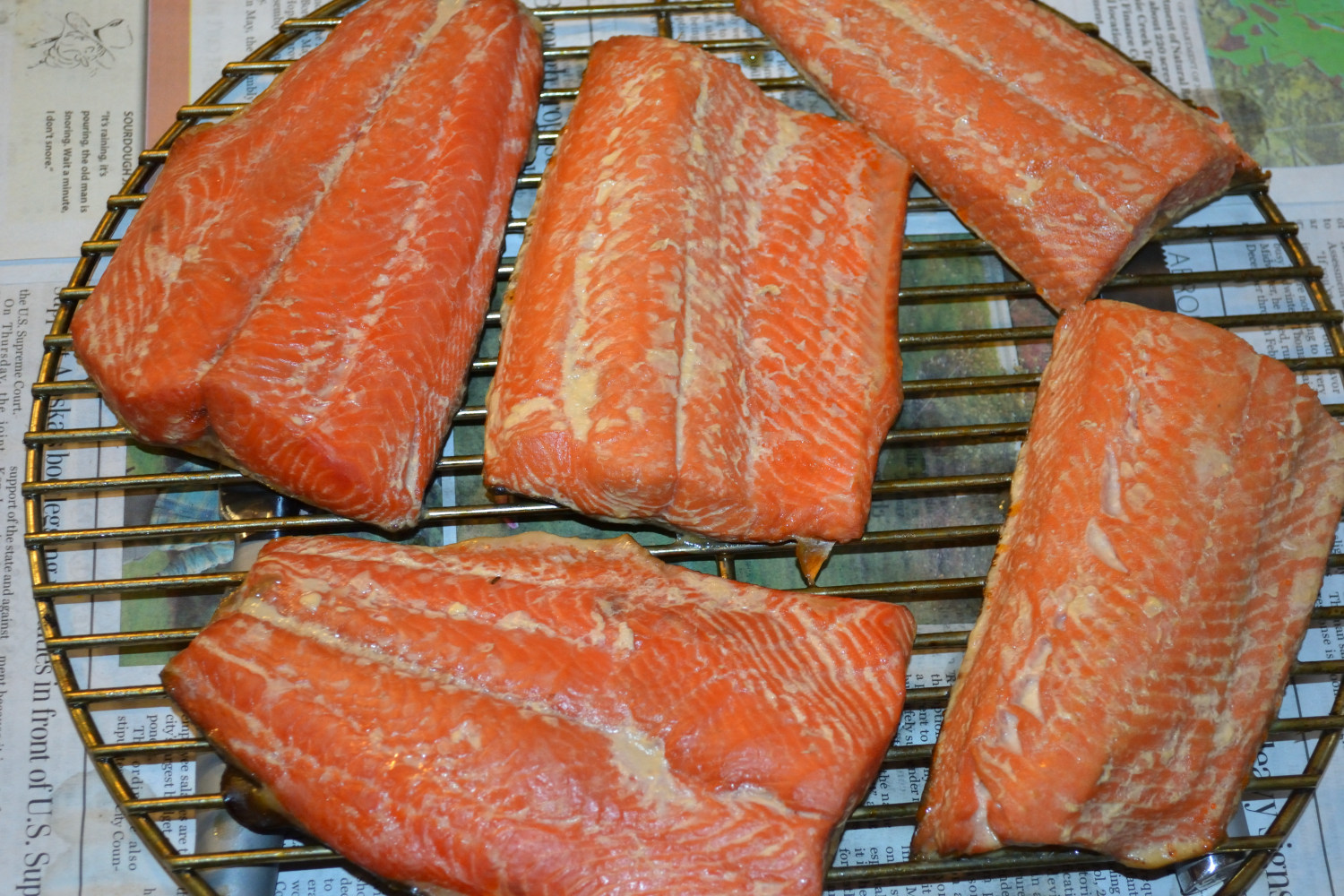
Smoked salmon fresh from the smoker.